The first time I saw Paul Debevec's Fiat Lux, I couldn't believe it.
It was shown at SIGGRAPH in 1999: enormous forms tumbling through St. Peter's Basilica, lit with this uncanny realism.
The trick was image-based lighting, building on Paul Debevec's paper Rendering Synthetic Objects into Real Scenes. The lighting had been captured at St. Peter's Basilica itself using a mirrored ball and high dynamic range photography.
I'd seen plenty of impressive rendering before, but this felt different.
The lighting wasn't an approximation of the place.
It was the place.
I wanted to know how to do that.
As the cameras and software became accessible enough, I started assembling my own setup for capturing high-dynamic-range panoramic images.
My first rig was entirely manual: a DSLR mounted to a panoramic head, shooting bracketed exposures in every direction. Then came the stitching, processing, and inevitable fixing of whatever I'd screwed up.
I kept at it.
By 2013 I'd upgraded to a robotic panoramic head, which made the process considerably more precise and repeatable. I began capturing much better environments, including locations at Pixar and while traveling.
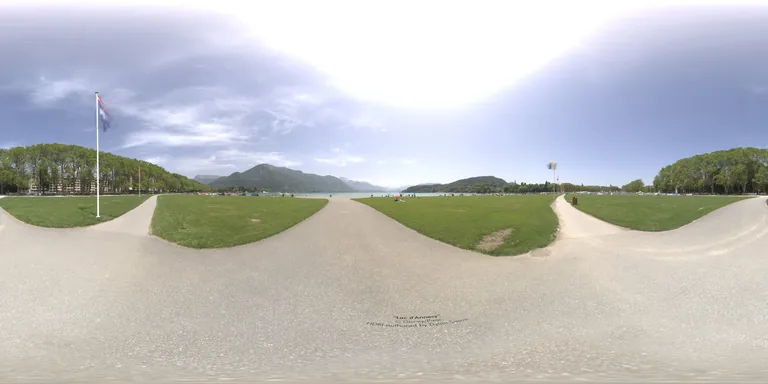
By Annecy 2014, I was using one of those panoramas to do exactly the thing that had fascinated me in Fiat Lux fifteen years earlier: putting CG objects into a photographed place and letting the place itself light them.
One light
What was so exciting about image-based lighting was how much complexity came almost for free.
Real places are ridiculously complicated to light using traditional methods. A real location isn't illuminated by three convenient lights. Light comes from the sun, the sky, the ground, buildings, windows, reflections, and whatever else happens to be nearby, all at different intensities.
Traditionally, an artist had to approximate all of that by placing and adjusting lights.
An HDR panorama could capture much of it at once.
Wrap the panorama around a CG scene and suddenly the object picks up the direction and color of the actual illumination.
One environment light could effectively replace a whole collection of carefully placed lights.
Today this is completely normal.
At the time, it felt like magic.
Capture the HDR on location, bring it into the renderer, and suddenly you had a remarkably good starting point for the lighting.
The joy of capture
Making the HDRIs was considerably less magical.
I'd mount a DSLR to the panoramic head, shoot a bracket of exposures, rotate the camera, shoot another bracket, and continue until I'd covered the entire sphere.
Lots of photographs.
Then all those images had to be stitched together and combined into a 32-bit HDR panorama.
Flattened out, the result looked...
like a panorama.
Taking it with me
Once I had a system that worked, I started traveling with it.
I was doing a lot of RenderMan presentations, and if I was somewhere interesting I'd sometimes capture an HDRI while I was there.
Annecy was perfect.
I photographed the Champ de Mars during the Annecy Animation Festival, surrounded by the lake, trees, buildings and French Alps.
Then I could take that environment back into RenderMan and put CG objects into it.
The CG wasn't just sitting in front of a photograph. It was being illuminated by the same place.
Which brought me right back to Fiat Lux.
Except now I was doing it myself.
With more teapots.
The Pixar HDRI
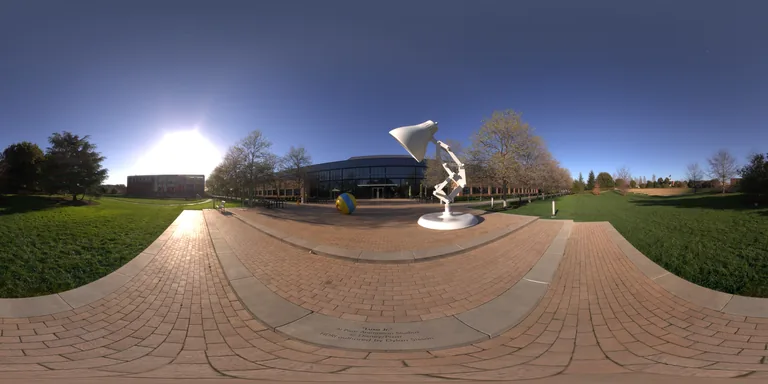
I also captured an environment at Pixar.
That one ended up having a surprisingly long life.
Good HDR environments were still relatively difficult to make, and there weren't nearly as many available as there are today. I had gone through all the trouble of making them, and there wasn't much reason other artists should have to.
So I put some of mine online for free.
The Pixar HDRI got downloaded a lot.
Over the years I've seen it show up in people's renders and experiments. I've even been told that Axis Studios used it as a default environment for realistic look development.
I have no idea how far it actually traveled.
I made these because I wanted to understand a new way of lighting CG. They turned out to be useful, so I gave them away. Then other artists used them to make their own things.
Try Them Yourself
The original Pixar and Annecy HDRIs are still here.
They're old now. There are vastly more sophisticated HDR environments available, made with better cameras, better software, and considerably less effort.
But they still work.